I've been occupied with other matters - The Singing Mountain is one, my illness is another - but I wanted to say more about this before I left it abandoned.
Shinichiro Watanabe, on the creation of Samurai Champloo.
To address the plot of SMTIV, we have to acknowledge one of the biggest elephants - a real Girimehkala - in the room with this game; that it is, to put it most kindly, politically narrow-minded.
Showing posts with label Rebuilding. Show all posts
Sunday, June 5, 2016
Friday, May 13, 2016
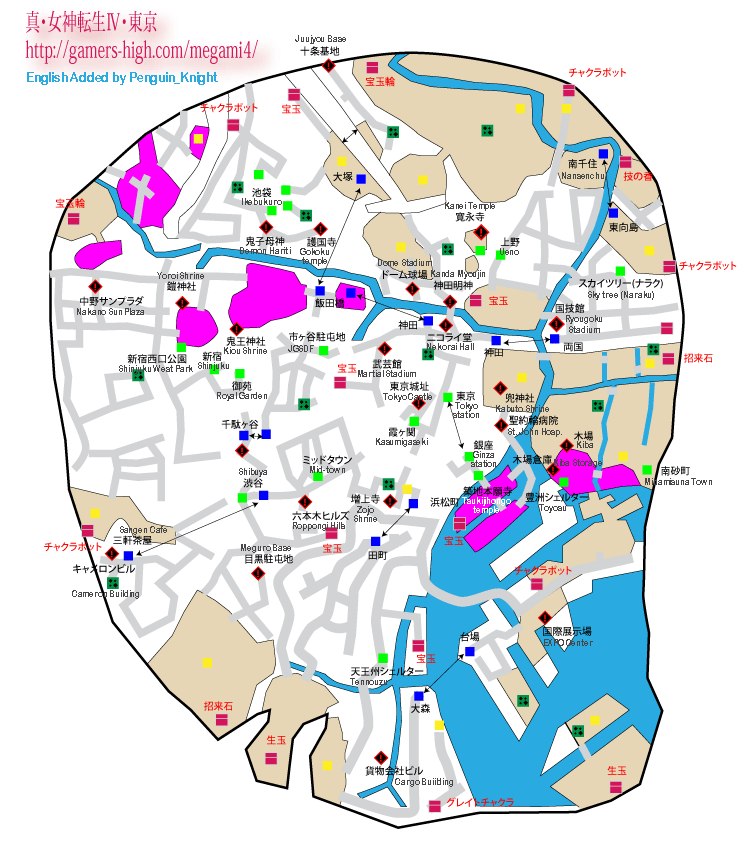
Rebuilding: SMTIV, Part Three (Exploring a Space)
In putting up P:B Flashback pieces, and getting to Kentucky Route Zero, I'm left wondering what the Hell I'm doing here. To spend this much time on the potential of this goofy ol' racist anime game when legitimate works of art like that game exist, it leaves me questioning everything about my entire life. But we're here, so we might as well go through with all of this!
Here's a positive note that I won't be able to put anywhere else: the soundtrack to SMTIV is pretty great. It's not the best in the series, by any means, but it's catchy and it fits the mood pretty consistently and they did a pretty good job. I enjoy it, it's in my rotation with other game scores.
Anyway, let's get into this mess. Welcome to Tokyo!
Here's a positive note that I won't be able to put anywhere else: the soundtrack to SMTIV is pretty great. It's not the best in the series, by any means, but it's catchy and it fits the mood pretty consistently and they did a pretty good job. I enjoy it, it's in my rotation with other game scores.
Anyway, let's get into this mess. Welcome to Tokyo!
Saturday, May 7, 2016
Rebuilding: SMT IV, Part Two (Establishing Identity)
Continuing a series on repairing and improving the disappointing Shin Megami Tensei IV...
Act One Summary
In the Eastern Kingdom of Mikado, Flynn and his longtime friend Issachar journey to the castle city where, beneath the statue of King Aquila, they undergo a testing rite, hoping to become samurai. Becoming a samurai is the only way for low-class casualries can become high-class luxurors, and samurai are believed to be noble keepers of the peace. At the rite, the "mystical gauntlet" rejects Issachar, but chooses Flynn, and he becomes one of a small crop of new samurai, including fellow casualry Walter and luxurors Isabeau, Jonathan, and Navarre. The following day, the role of a samurai is laid out by their leader, Hope - they are charged with exterminating the demons within Naraku (the underworld), the entrance to which lies right beneath the statue plaza. The "gauntlet" is actually a computer wristband from a Demonica suit, with an in-built AI named Burroughs, who aids Flynn as he gets used to killing - and recruiting - demons.
During the days, Flynn performs his duties, but at night he is tortured by dreams in which these new people he has met - and a few others - suggest he will have to choose the path the world will take, either into ruin or into order. He is also entreated by a young girl, who wants him to help her "be reborn." Meanwhile, Navarre, who is pampered and arrogant, attempts to lay a trap for the two casualry samurai, but blunders into a demon domain and his spirit is crushed, causing him to quit.
It is soon revealed that all is not well in Mikado, as someone called the Black Samurai is distributing something called "literature" to the masses, and the enlightened casualry give in to rage or despair, becoming demons themselves, including the resentful Issachar. As Flynn's home village burns, the samurai confront the Black Samurai and she (who, unbeknownst to the samurai, is also wearing a Demonica suit herself) escapes, telling them that their answers lie in the City of the Unclean Ones, which lies at the bottom of Naraku.
The castle monastery, particularly Abbot Hugo, who is being advised by a mysterious "Sister Gabby," orders the samurai to violate their own code and travel deeper into Naraku in pursuit of the Black Samurai - if only to add more mystical relics (lost modern technology) to the monastery vaults. The samurai find, guarding the way further down, a Minotaur, who was one of the demons subordinate to Aquila himself, a sad and noble demon whose death leaves them with questions. As they travel on, they find man-made rooms storing strange "guns," matter-transporting "terminals," and signage implying that what is above - that is, them - is what's to be feared. Further down they find an observation deck and look out at a ruined Tokyo - "Naraku" has been the Tokyo Sky Tower all along, and ruined, post-apocalyptic Tokyo is covered in a stone dome atop which Mikado has sat for generations (it will become clear later, if not entirely well-conveyed, that time passes differently above and below), with "Naraku" as the only passage between them. After battling Medusa, they take an elevator the rest of the way down and find a pair of thugs answering to someone named "Tayama" - who Medusa had also mentioned - who call the samurai "angels from above" and flee.
Realizing they understood nothing of the world as it really was, the samurai set out to explore Tokyo and find the Black Samurai.
Initial Thoughts
The opening act of SMTIV is its strongest sequence. It's very clever - so clever, in fact, that I'm inclined, perhaps unfairly, to attribute it all to Kazuma Kaneko's original treatment of the material, and not any of the game's actual writers. It works better than any part that follows it, even if it's not a "complete thought," as it were, and it is essentially all tutorial. In rebuilding this game, we're going to do the unthinkable - make the tutorial section of the game much longer.
Wednesday, May 4, 2016
Rebuilding: SMT IV, Part One (Overview)
Rebuilding is a marriage of criticism and pure self-indulgence where I try to repair a narrative game that showed potential but didn't work. Some degree of familiarity with the game in question is probably recommended.
I've been replaying Shin Megami Tensei IV in preparation for its upcoming sequel, SMTIV: Apocalypse (called SMTIV: Final in Japan), and experiencing all over again all the things I didn't like about it the first time. The first game did well financially - in terms of a portable-release Japanese RPG in this generation - but it's a not very hidden secret that the sequel's a saving throw by developer Atlus after a wave of complaints. A lot of people liked SMTIV, but few loved it, and many were very, very angry. Myself, I was just disappointed. On the old Project: Ballad blog, I had a long-running letter series with critic David Brothers at the time of the game's US release, and while there's much there I'd just as soon forget, it served as a very public record of the transition from anticipation to enjoyment, to reservation, to frustration, to finally abandonment. I tossed the thing shortly after the reveal of the Black Samurai's identity, and didn't come back to it until this past month.
In replaying with full knowledge of the game's story from beginning to end and fewer expectations, I can see lots of places where the game does work, but even more where it does not than I even noticed at the time. The game tries to walk a fine line between what a mainline Shin Megami Tensei game has always been and what the company's modern audience wants it to be, and it fails - but more than that, it suffers from a surfeit of ideas and the inability to fully carry any of them out. The potential is all there.
Word is already out on the sequel, and it seems to have doubled down on both sides - fixing many long time fans' complaints, but also pushing further to make the game closer resemble spin-off titles that sell better, like the Persona series, and the friction is frustrating to many - though perhaps few will see it that way, as many gameplay decisions are thought through more fully in this second game, and for many that will be enough.
In this series, we're going to go through the game(s) one step at a time, one sequence at a time, and see if we can't more fully realize what they were attempting to do, in a way that is more respectful to the series' history, its fans, and also to our intelligence as consumers of narrative media.
I've been replaying Shin Megami Tensei IV in preparation for its upcoming sequel, SMTIV: Apocalypse (called SMTIV: Final in Japan), and experiencing all over again all the things I didn't like about it the first time. The first game did well financially - in terms of a portable-release Japanese RPG in this generation - but it's a not very hidden secret that the sequel's a saving throw by developer Atlus after a wave of complaints. A lot of people liked SMTIV, but few loved it, and many were very, very angry. Myself, I was just disappointed. On the old Project: Ballad blog, I had a long-running letter series with critic David Brothers at the time of the game's US release, and while there's much there I'd just as soon forget, it served as a very public record of the transition from anticipation to enjoyment, to reservation, to frustration, to finally abandonment. I tossed the thing shortly after the reveal of the Black Samurai's identity, and didn't come back to it until this past month.
In replaying with full knowledge of the game's story from beginning to end and fewer expectations, I can see lots of places where the game does work, but even more where it does not than I even noticed at the time. The game tries to walk a fine line between what a mainline Shin Megami Tensei game has always been and what the company's modern audience wants it to be, and it fails - but more than that, it suffers from a surfeit of ideas and the inability to fully carry any of them out. The potential is all there.
Word is already out on the sequel, and it seems to have doubled down on both sides - fixing many long time fans' complaints, but also pushing further to make the game closer resemble spin-off titles that sell better, like the Persona series, and the friction is frustrating to many - though perhaps few will see it that way, as many gameplay decisions are thought through more fully in this second game, and for many that will be enough.
In this series, we're going to go through the game(s) one step at a time, one sequence at a time, and see if we can't more fully realize what they were attempting to do, in a way that is more respectful to the series' history, its fans, and also to our intelligence as consumers of narrative media.
Subscribe to:
Posts (Atom)